


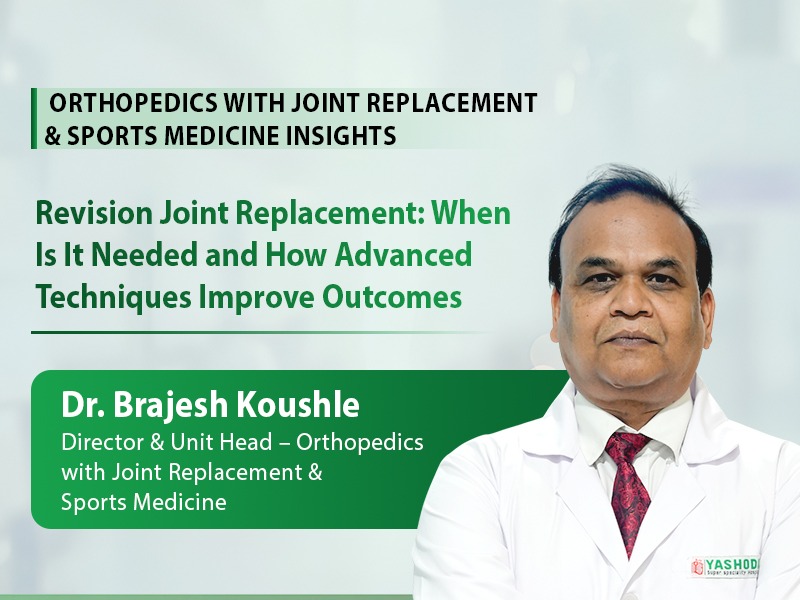
Revision Joint Replacement: When Is It Needed and How Advanced Techniques Improve Outcomes
While a primary joint replacement is, in many cases, a real breakthrough, happily leading to an elimination of painful mobility problems, making sure that your second chance at walking is also of top quality is the work of a master specialist. In Orthopedics, Joint Replacement & Sports Medicine, primary surgeries have excellent success rates. Nonetheless, over time, some implants may require a sophisticated revision surgery.
If you want to hire the services of the top Orthopedic & Joint Replacement Doctor in Delhi NCR, learning about the intricacies of revision surgery will be the first step in your journey to recovery. At Yashoda Medicity, we bridge the gap between clinical excellence and world-class technology to ensure your revision surgery delivers long-term stability and comfort.
What Defines a Revision Joint Replacement?
A revision joint replacement is surgery performed when a previous joint replacement fails. Primary surgery replaces the natural joint surfaces with implants, whereas revision is a complex procedure. In a revision, part or all of the original prosthesis is removed, and the space is filled with new components.
Furthermore, the bone around the original implant may be weakened or even missing. Hence, specialists frequently use specialised implants with longer, thicker stems that extend further into the bone. Thus, granting greater stability. This operation requires careful planning and a high level of surgical skill to restore the joint’s function.
Why Would a Primary Joint Replacement Fail?
Even successful surgeries can encounter problems over time. Finding the “why” is the first step for an Orthopedic & Joint Replacement Specialist in Delhi NCR to determine the appropriate treatment.
1. Implant Loosening and Wear
For a joint to work, the implant must be securely fixed to the bone. However, over time, if a person is involved in many high-impact activities or has excessive body weight, this may lead to loosening of the implant. Moreover, minute particles from the plastic spacer may trigger an immune response (called osteolysis), and the bone around the metal parts is eaten away as a result.
2. Infection
It is possible that infection develops even several weeks or years after a surgery. Microorganisms can form colonies on the metal and plastic surfaces, causing pain, swelling, and a limited range of motion. Revision surgery to address infection is typically performed in multiple steps:
Stage 1: Take out the implant and put an antibiotic spacer.
Stage 2: Put in a new prosthesis after the infection has been eliminated.
3. Instability and Stiffness
When ligaments supporting the joint are damaged or the balance between them is wrong, one might feel as if the joint is “giving way”. On the other hand, an overgrowth of scar tissue (fibrosis) may make the joint so rigid that it becomes a major problem even for simple daily activities.
4. Periprosthetic Fractures
Sometimes a fall or other trauma can break a bone next to the implant. If the bone is broken into pieces or the implant is out of place, the usual solution is a revision operation with bigger components or the use of bone grafts.
Primary vs. Revision Surgery: Key Differences
Complexity
-
-
Primary Joint Replacement: A standard surgical procedure.
-
Revision Joint Replacement: Highly complex and specialised surgery.
-
Duration
-
-
Primary Joint Replacement: Usually takes around 1–2 hours.
-
Revision Joint Replacement: Takes significantly longer due to the removal of old implants.
-
Implants Used
-
-
Primary Joint Replacement: Uses standard sizes and shapes of implants.
-
Revision Joint Replacement: Requires specialised implants with longer stems and augments.
-
Bone Quality
-
-
Primary Joint Replacement: Typically performed on healthy bone.
-
Revision Joint Replacement: Often requires bone grafts or metal augments because bone quality may be compromised.
-
Recovery
-
-
Primary Joint Replacement: More predictable and relatively faster recovery.
-
Revision Joint Replacement: Longer recovery period, often requiring intensive physiotherapy.
-
Meet the Expert: Dr. Brajesh Kumar Koushle
One of the main factors determining the success of a revision replacement operation as complex as this is the surgeon’s experience. Dr. Brajesh Kumar Koushle is Yashoda Medicity’s Director and Unit Head Orthopaedics with Joint Replacement & Sports Medicine at Indirapuram. Dr. Brajesh Kumar Koushle is a reputed figure in the field with over 25 years of clinical experience. Since 2010, he has been the orthopaedic consultant to the Indian Athletics Team and the Indian Olympic Association, thereby having world-class sports medicine at his disposal for each patient.
His major skills are:
- Revision & Primary Joint Replacements (Knee, Hip, Shoulder)
- Joint Replacement Robotic Surgery
- Arthroscopic Ligament Reconstructions (ACL/PCL)
- Complex Trauma & Road Traffic Accident (RTA) Injuries
- Reverse Shoulder Replacement
Reclaim Your Mobility at Yashoda Medicity
If the joint you had replaced earlier has become painful or unstable, then don’t just accept the limited movement. As a renowned centre for Orthopaedics, Joint Replacement & Sports Medicine, Yashoda Medicity is ready to provide you with the latest technology and treatments to support successful revision surgery. Our team of experts from various fields, headed by a well-known surgeon like Dr Brajesh Kumar Koushle, works together to ensure each patient receives a treatment plan tailored to their body features and life goals.