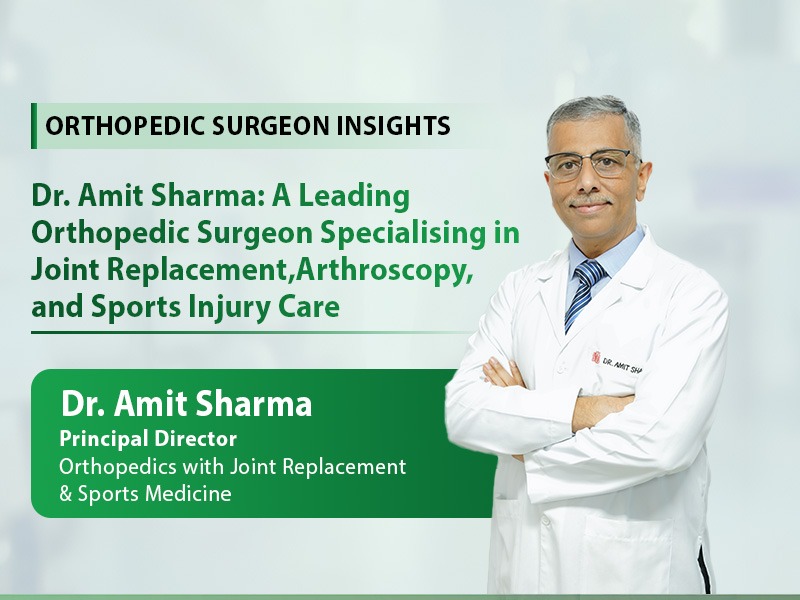
Dr. Amit Sharma: A Leading Orthopedic Surgeon Specialising in Joint Replacement, Arthroscopy, and Sports Injury Care
Regaining your mobility should not leave you exhausted, mentally or physically. Thanks to the advances in medical science, rehabilitation is often quicker than the injury was sudden. Those who suffer from chronic pain or have experienced a recent trauma can look at getting an Expert Orthopedic, Joint Replacement & Sports Medicine Doctor in Delhi NCR as their first step to their next pain-free lifestyle. At Yashoda Medicity, we combine surgical expertise with compassionate care so that each patient can enjoy a multidisciplinary approach tailored to the person’s musculoskeletal requirements.
What is Minimally Invasive Joint Replacement & Sports Injury Surgery?
Minimally Invasive Joint Replacement & Sports Injury Surgery refers to new surgical procedures that use small incisions and specialized tools to repair or replace defective joints. Traditionally, the term “open” surgeries was used to describe more extensive surgeries that do not focus on preserving muscles or ligaments.
One advantage is that the operating team does not have to cause a major disruption to the soft tissue to achieve the final goal of an internally structured surgery, e.g., total knee or hip replacement. At the same time, using the same internal structural goals can significantly reduce the physiological “insult” to the body. This is really a game-changer for athletes and very active people who want to be in their best shape as soon as possible.
How Does Robotic-Assisted Surgery Improve Patient Outcomes?
Bringing in technologies like the Cuvis Robotic Knee Replacement system has really changed the idea of precision in the operating room. This system comes with a surgical plan tailored to the patient, based on a 3D model of the person’s unique anatomy.
Ultra-accurate: The implant is aligned so perfectly that it will hardly wear down over time.
Better Tissue Preservation: The robot arm provides haptic feedback to the surgeon, helping prevent healthy tissue around the operative area from being damaged.
Reliability: Using robotic tools during surgery eliminates the element of “human error” in cutting bone, resulting in more successful and long-lasting outcomes.
What are the Benefits of Minimally Invasive Techniques (MIS)?
There are various clinical benefits to choosing MIS over conventional surgery. Since the biological “cost” of the operation is lower, the body can concentrate its energy on joint healing rather than on large surgical wound repair.
Key Benefits of MIS:
Less Blood Loss: Smaller incisions mean significantly less bleeding during the operation.
Minimal Scarring: It improves the aesthetic results, and there is less internal scar tissue.
Lower Pain Levels: Patients typically have to take fewer opioid painkillers after the surgery.
Shorter Hospital Stays: Some patients can walk within a few hours and be discharged much earlier than with traditional methods.
Which Joint Replacement Options are Available for Arthritis Patients?
For those suffering from osteoarthritis, rheumatoid arthritis, or degenerative bone disease, a range of prosthetic solutions exists to restore movement.
Total Knee Replacement
Targeted Condition: Advanced osteoarthritis.
Primary Benefit: Helps provide complete relief from chronic knee pain and improves mobility.
Total Hip Replacement
Targeted Condition: Hip dysplasia or joint degeneration.
Primary Benefit: Restores the full range of hip movement and improves walking ability.
Unicondylar Knee Replacement
Targeted Condition: Early-stage localized arthritis affecting one part of the knee.
Primary Benefit: Preserves healthy natural knee structures while relieving pain.
Shoulder & Elbow Replacement
Targeted Condition: Severe joint trauma or wear and tear.
Primary Benefit: Restores joint function and helps patients perform daily activities such as lifting and movement.
Can Complex Limb Deformities and Trauma be Treated with MIS?
Yes. Most of the advanced hospitals have Action Limb sub, which are focused on the treatment and correction of bone realignment and discrepancy challenges. Using surgical methods such as Ilizarov or Rail Fixators, doctors can treat limb length discrepancies of up to 10 cm.
When severe trauma cases with multiple fractures are involved, the use of minimally invasive procedures benefits trauma patients severely injured in multiple organ systems (polytrauma patients) by providing them with stabilized care with minimal systemic stress. Typically, a multidisciplinary team comprising neurosurgeons, plastic surgeons, and intensivists collaborates to ensure a comprehensive recovery.
Indoor and outdoor sports, exercise, and daily activities are necessary for a healthy, long life, but they come at the cost of wear and tear on your joints and muscles. You may be wondering why certain joints, such as knees or hips, or perhaps your lower back, are causing pain, especially after exercising. Diagnosing the problem correctly is a must before treatment can be planned. Our specialized sports injury team at Yashoda Medicity, trained and experienced in diagnosing and managing sports injuries, is readily available to guide you through the assessment and treatment of the injury that has been holding you back.
Don’t worry, we have got you covered for every stage of your recovery from injury, from the surgical intervention to postoperative recovery and rehabilitation with sleeves