


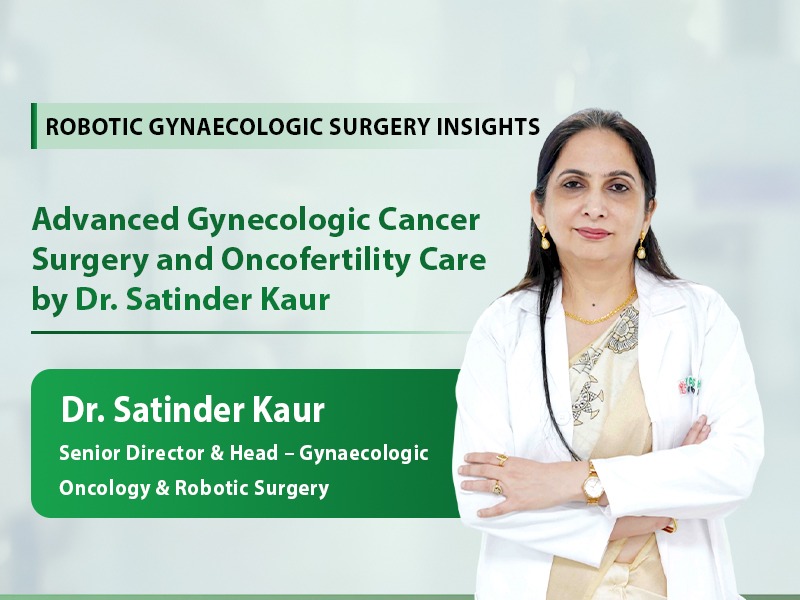
Advanced Gynecologic Cancer Surgery and Oncofertility Care by Dr. Satinder Kaur
Navigating a cancer diagnosis is an incredibly tough life situation, but the desire to become a mother should not be sacrificed to the treatment. Women who have been diagnosed with reproductive tract cancers can have the promise of a family in the future through oncofertility, a highly specialised branch of medicine that deals with preserving fertility.
As one of the top Gynecologic Oncologist in Delhi NCR, Dr. Satinder Kaur is leading this transformation by combining the highly technical aspects of surgery with empathetic, fertility-preserving methods. At Yashoda Medicity, patients get access to the top treatment, which firstly focuses on total cancer removal and simultaneously safeguards their reproductive potential.
The Landscape of Gynecological Cancers and Fertility
Gynaecological cancers are one of the major health problems of women, and they make up about 15%, 20% of cancers in women. According to the statistics, breast cancer is the most common type of cancer (46.9%), but cervical cancer (32.26%) and ovarian cancer (15.24%) still remain the major problems.
Significantly, nearly one-fifth of these cases involve women below 40 years old. Even though the percentage of people surviving has become very high, the use of radical surgery, chemotherapy and radiation as treatments may cause infertility. Chemotherapy can use up the ovarian reserve, while radiation can harm the uterine lining or bring on premature ovarian failure. Advanced Gynecologic Cancer Surgery and Oncofertility Care are designed to prevent such outcomes through tailored, multidisciplinary interventions.
Who is Dr. Satinder Kaur?
As a top-tier expert in her field, Dr. Satinder Kaur is widely recognized for her elite clinical foundation at the prestigious Tata Memorial Hospital, Mumbai. Her surgical precision is further sharpened by prestigious international fellowships from the Asian Society for Gynecologic Oncology (ASGO, Australia) and the European Society for Gynecologic Oncology (ESGO, Europe). These global credentials empower her to deliver advanced surgical standards and evidence-based oncological care within the Delhi NCR region.
- Minimal Access Surgery: Laparoscopic and Robotic, assisted surgeries.
- Complex Cytoreductive Surgery: Including HIPEC for advanced ovarian cancer.
- Oncofertility: Care and preservation of reproductive organs using specialised methods.
Oncofertility: A Multi-Disciplinary Approach
Oncofertility is a specialised healthcare among oncologists, gynaecologists, endocrinologists, and psychologists. It is aimed at offering counselling services just in time before a cancer treatment cycle starts. International guidelines (e.g., ASCO) recommend that the youth be informed about the chances of infertility due to treatment as well as the fertility preservation methods available to them.
Fertility-Sparing Strategies in Cervical Cancer
Cervical cancer treatment mostly includes a radical hysterectomy, during which the womb is removed. Nevertheless, Dr. Satinder Kaur is performing the advanced surgery in such cases of cervical cancer where the criteria are strictly met (tumour < 2cm, no lymph node involvement, and of specific cell types like squamous cell carcinoma, etc.)
Conization
- Description: Removal of a cone-shaped portion of the cervix containing abnormal or cancerous cells.
- Fertility Outcome: Fertility is usually well preserved, as most of the uterus remains intact.
Radical Trachelectomy
- Description: Surgical removal of the cervix and upper part of the vagina, while preserving the uterus.
- Fertility Outcome: Pregnancy is still possible, but delivery typically requires a C-section.
Ovarian Transposition
- Description: A procedure where the ovaries are moved higher in the abdomen using laparoscopy to protect them from radiation therapy.
- Fertility Outcome: Helps preserve ovarian function and fertility during cancer treatment.
Oocyte Cryopreservation
- Description: The process of retrieving and freezing mature or immature eggs for future use.
- Fertility Outcome: Enables future pregnancy through IVF or surrogacy.
Advanced Surgical Techniques for Better Outcomes
As a leading Gynecologic Oncologist, Dr. Stainder Kaur strongly advocates Minimal Access Surgery (Laparoscopic and Robotic) for her patients. These methods give a considerable advantage over conventional open surgeries:
- Shorter Recovery Period: Patients can return to their routine and may initiate adjuvant therapies sooner.
- Lower Infection Risk: Minor incisions significantly reduce the risk of complications.
- Greater Accuracy: The 3D visualisation offered by robotic platforms is very helpful for preserving nerves and tissues during Gynecologic Cancer Surgery and Oncofertility Care.
Specialized Surgical Interventions at Yashoda Medicity
1. Cytoreductive Surgery and HIPEC for Ovarian Cancer
For advanced ovarian cancer, the goal is “maximal debulking” or Cytoreductive Surgery. This involves removing all visible tumor masses from the abdominal cavity.
- HIPEC (Hyperthermic Intraperitoneal Chemotherapy): Following surgery, a heated chemotherapy solution is circulated within the abdomen. Heat increases the sensitivity of cancer cells to drugs, allowing higher local doses with fewer systemic side effects, significantly improving survival rates for stage III and IV patients.
2. Robotic and Laparoscopic Cancer Surgeries
Dr. Satinder Kaur advocates for minimal access surgery to improve patient outcomes. Robotic platforms provide 3D visualization and greater dexterity, which is crucial for:
- Radical Hysterectomy: Precise removal of the uterus and surrounding tissues while sparing delicate nerves.
- Faster Recovery: Smaller incisions lead to less pain, a lower risk of infection, and a quicker return to adjuvant therapies.
3. Radical Vulvectomy and Reconstructive Care
In cases of vulvar cancer, a radical vulvectomy may be required to remove the tumor along with a margin of healthy tissue and nearby lymph nodes. At Yashoda Medicity, this is performed with a focus on both oncological safety and psychosexual well-being, often involving reconstructive techniques to preserve form and function.
4. Exenterative Procedures for Recurrent Cancers
When cancer returns to the pelvis after prior radiation or surgery, Pelvic Exenteration may be the only curative option. This ultra-radical surgery involves the en bloc removal of the affected reproductive, urinary, and gastrointestinal organs. While complex, it offers a chance for long-term survival in otherwise difficult-to-treat recurrent cases.
Oocyte (Egg) Cryopreservation Process
For women whose ovaries might be damaged due to chemotherapy or radiation, egg freezing is an essential option.
The procedure comprises:
- Ovarian Stimulation: A couple of weeks of hormone shots to make the ovaries produce several eggs.
- Monitoring: Follicle growth is checked by doing a trans, vaginal ultrasound.
- Retrieval: A short, light anaesthesia operation to get the oocytes.
- Storage: Eggs are frozen and stored as “mature metaphase II eggs” until the patient decides to have a baby.
Conclusion: Empowering Women at Yashoda Medicity
The cancer journey is tough and hard on us, but it doesn’t mean you have to give up on your fertility dreams. When you choose a gynecologist, such as Dr. Satinder Kaur, you are choosing a doctor who cares about your future as much as your present health.
At Yashoda Medicity, we bring together state-of-the-art robotic technology with the sensitive care of oncofertility to give each woman a hopeful chance of becoming a mother. Whether it’s preventive of complex recurrent cancers, our team is committed to providing not only holistic but also life-affirming results.