


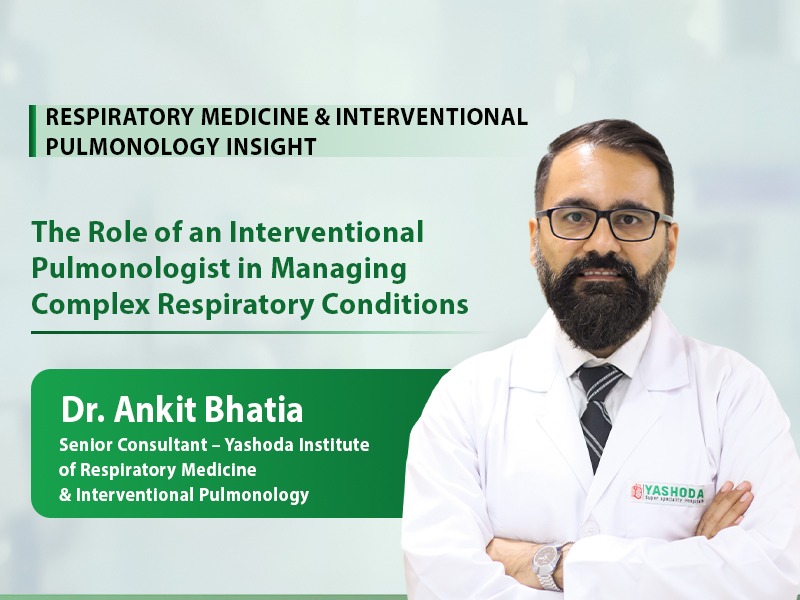
The Role of an Interventional Pulmonologist in Managing Complex Respiratory Conditions
In a critical care unit, a pulmonologist’s expertise at Yashoda Medicity Ghaziabad can be the key to a patient’s successful recovery rather than to the patient’s struggle to breathe. The speciality of Pulmonology & Sleep Medicine has been completely revolutionised, shifting from a mainly diagnostic branch to a source of a range of life-saving treatments.
Interventional pulmonologist in Delhi NCR (IP) is a rapidly getting advanced subspecialty that pulmonologists have made a significant resource for intensivists. It provides elaborate solutions for complex airway, lung, and pleural diseases that had been considered untreatable. IP specialists deliver the most advanced care to patients in the intensive care unit (ICU) by using the latest technology and minimally invasive procedures.
How Does Interventional Pulmonology Support Critical Care?
Interventional Pulmonology (IP) was once considered a marginal service, but today it is a major player in the multidisciplinary care of complex patients. In the critical care unit, an interventionalist is performing complex respiratory system procedures. They are capable of immediate stabilisation of patients with respiratory failure due to hemoptysis (coughing up blood), central airway obstruction, or advanced malignancies. Through instant procedural interventions, they effectively shorten the distance between traditional medicine and thoracic surgery.
Managing Central Airway Obstruction (CAO) and Hemoptysis
Central Airway Obstruction (CAO) is a medical condition that can be life-threatening, threatening and its causes are diverse. For example, it can be due to cancer, inhalation of a foreign object, formation of blood clots, or heavy mucus impaction.
An interventional pulmonologist is provided with various advanced tools to rescue an obstructed airway:
- Rigid Bronchoscopy: Acts as a stable “tunnel” for the removal of the obstruction or the placement of a stent.
- Argon Plasma Coagulation (APC): A non-contact method wherein the tissue is heated to control bleeding and reduce the size of tumours.
- Cryotherapy: The use of extreme cold to extract tissues, blood clots, or mucoid impactions that obstruct the airways.
The Utility of Endobronchial Ultrasound (EBUS) in the ICU
The ICU diagnostic landscape has basically been changed overnight by Endobronchial Ultrasonography (EBUS). It lets the doctor have a direct view of the structures outside the wall of the airway, live. So, it is a major factor in decisions made at the following clinical scenarios:
- Pulmonary Vascular Issues: Finding clots or measuring the change in pressure in the pulmonary system.
- Mediastinal Staging: Mediastinal lymph node biopsy guided by endobronchial ultrasound for accurate staging of lung cancer or the detection of sarcoidosis.
- Infection mapping: Identification of deep, seated abscesses by extrapulmonary ultrasound, which may not be localised by conventional radiology methods.
Bedside Procedures: Improving Outcomes and Efficiency
One of the most significant benefits of Interventional Pulmonology and Critical Care is the ability to perform high-level procedures at the patient’s bedside. This eliminates the risks associated with transporting a critically ill, ventilated patient to an operating room.
Percutaneous Tracheostomy
- Indication: Performed for patients who require prolonged dependence on mechanical ventilation.
- Economic / Clinical Benefit: Helps reduce ICU stay duration and lowers the risk of infections.
Percutaneous Gastrostomy
- Indication: Used when a patient requires long-term nutritional support through the stomach.
- Economic / Clinical Benefit: The procedure can be performed at the bedside under ultrasound guidance, making it safer and more convenient.
Pleural Catheterization
- Indication: Used for the management of recurrent pleural effusions (fluid accumulation around the lungs).
- Economic / Clinical Benefit: Provides immediate relief from breathlessness and may help avoid more invasive surgery.
The Role of Pleural Disease Management
Pleural diseases like major pleural effusions or pneumothorax (lung collapse) are commonly seen in ICU or critical care units. A methodical approach to these problems should be the first step. Therapeutic bronchoscopists have expertise in advanced thoracentesis as well as pleurodesis (sticking the lung to the chest wall) to stop the fluid from recurring, which is very important for patients with chronic pulmonary diseases or those who are in the terminal stage of their disease.
Experience Advanced Respiratory Care at Yashoda Medicity
Managing chronic lung disease or acute respiratory failure can be a tough journey. Selecting the right medical partner can significantly impact the outcome of your treatment. The Department of Pulmonology & Sleep Medicine at Yashoda Medicity is considered one of the best in respiratory intervention. Our strong facility is ready to support the diagnosis and treatment of any condition, with advanced equipment and techniques such as EBUS, guided diagnostics, and rigid bronchoscopy suites. That means our patients always receive pinpoint-accurate treatment.
Seeing a Pulmonologist at Yashoda Medicity Ghaziabad means that you will get more than just a doctor’s appointment because your doctor will be part of a comprehensive healing system that incorporates the most advanced and least invasive methods, and ensures fast recovery. Yashoda Medicity is focused on helping you breathe better, thus enabling a more satisfying and active life.