


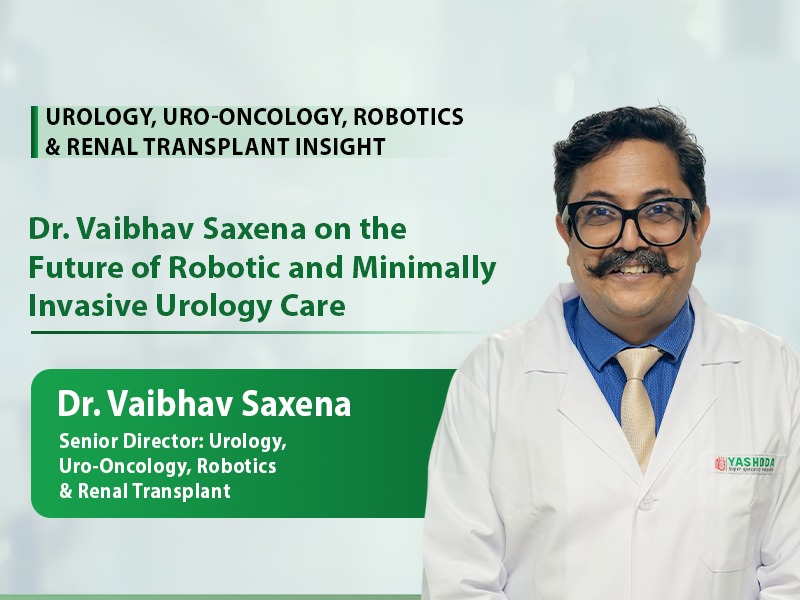
Dr. Vaibhav Saxena on the Future of Robotic and Minimally Invasive Urology Care
Minimizing recovery time replaces tough decisions about surgery and long healing periods. In Delhi’s NCR region, doctors are moving from major surgeries to minor, precise procedures. Dr. Vaibhav Saxena, urologist in Ghaziabad, uses these modern methods with high skill. The shift isn’t just in tools. It’s about less patient pain and better outcomes. Robots and advanced laparoscopy help make surgeries more accurate. These techniques let surgeons control the operation with steady precision. More patients now get safe care with shorter downtime. Recovery has become faster, less stressful, and more predictable. Patients feel better sooner after treatment. This change reflects real progress in surgical care.
The Evolution: From Traditional Open Surgery to Robotic Precision
For many years, doctors performed kidney, bladder, and prostate surgeries with big cuts in the abdomen. These operations helped patients survive, but they usually led to heavy bleeding, obvious scars, and hospital stays lasting several weeks.
In the past twenty years, minimally invasive surgery has become more common. This method uses small cuts and high-quality video cameras to guide procedures inside the body. Robotic-assisted techniques go beyond this model. It seems the robot doesn’t work alone; it’s a precise tool that converts the surgeon’s hand motions into tiny movements, reducing small tremors and showing a 3D, magnified view of the area. Arguably, this setup reduces damage to surrounding tissue. The outcome probably improves recovery time and patient comfort, though not by much. It tends to result in less pain and shorter hospital stays.
Why Robotics is the Preferred Choice for Patients
From the patient’s point of view, switching to robotic care is a good idea. When seeing a top urologist in Delhi NCR, people usually want to get back to everyday life fast. Robotic systems offer:
- Smaller incisions lead to less post-surgery pain.
- This is a clear benefit.
- Patients often leave the hospital within 1 to 3 days, not a week or more, as with open procedures.
- In places like the prostate, the robot’s accuracy helps protect nerves that control bladder and sexual function.
- The risk of infection decreases, and blood loss is minimal; sometimes, no transfusions are needed at all.
Comparative Overview: Open Surgery vs. Robotic Surgery
Traditional Open Surgery
- Incision Size: Requires a large incision of about 6–10 inches.
- Blood Loss: Usually moderate to high compared to minimally invasive techniques.
- Hospital Stay: Patients may need to stay in the hospital for 5–10 days.
- Recovery Time: Full recovery typically takes around 6–8 weeks.
- Precision: Surgery is performed manually using the surgeon’s direct vision.
Robotic-Assisted Surgery
- Incision Size: Uses small keyhole incisions of about 1–2 centimeters.
- Blood Loss: Generally minimal due to precise surgical control.
- Hospital Stay: Patients often stay in the hospital for only 1–3 days.
- Recovery Time: Recovery is usually faster, around 2–3 weeks.
- Precision: Provides enhanced 3D visualization with up to 10× magnification, allowing greater surgical accuracy.
Common Urological Procedures Leveraging Robotic Technology
Dr. Vaibhav Saxena, a respected urologist in Ghaziabad, probably uses these modern methods for various difficult cases. Robotics has become the standard choice for treating several conditions. In uro-oncology, he performs radical prostatectomies for prostate cancer and partial nephrectomies to remove tumors while keeping the kidney. He also does pyeloplasty to fix blockages in the urinary system. For bladder issues, he carries out cystectomies for cancer, often including complex urinary diversion. In kidney transplants, he makes accurate vascular sutures during both donor and recipient procedures. But patients often report better recovery outcomes with this method.
Is Robotic Surgery Right for Every Patient?
Surgical decisions depend on many personal factors. The disease’s progression, the patient’s medical condition, and past surgery all matter. A knowledgeable doctor decides if robotic, laparoscopic, or open methods are best for safety and results. Technology improves only when used properly. The surgeon’s hands and experience lead to the final result. Expert judgment always outweighs equipment advancements. Success comes from trained skill, not just tools. Patient outcomes reflect the surgeon’s training and real-world performance.
The Future of Urology at Yashoda Medicity
Robotic urology in India is expanding rapidly, especially in the Delhi NCR area, where medical advances are being developed. Dr. Vaibhav Saxena leads this shift with strong experience in Endourology, Laparoscopic Urology, and Renal Transplantation. His practice in Ghaziabad blends modern technology with a focus on patient needs. Each patient receives top-quality treatment customised to their specific condition. For cases involving cancer or surgical reconstruction, care is delivered with accuracy and kindness. The approach is designed to support better health outcomes and reduce risks during procedures.
At Yashoda Medicity, patients have access to the most current robotic systems. These tools help deliver fast and safe results for urological conditions. This option is available to people or family members who need advanced urological services. For now, the results reflect improvements in treatment precision and recovery time. Trusting Dr. Vaibhav Saxena means choosing a provider committed to innovation and individualized care.