


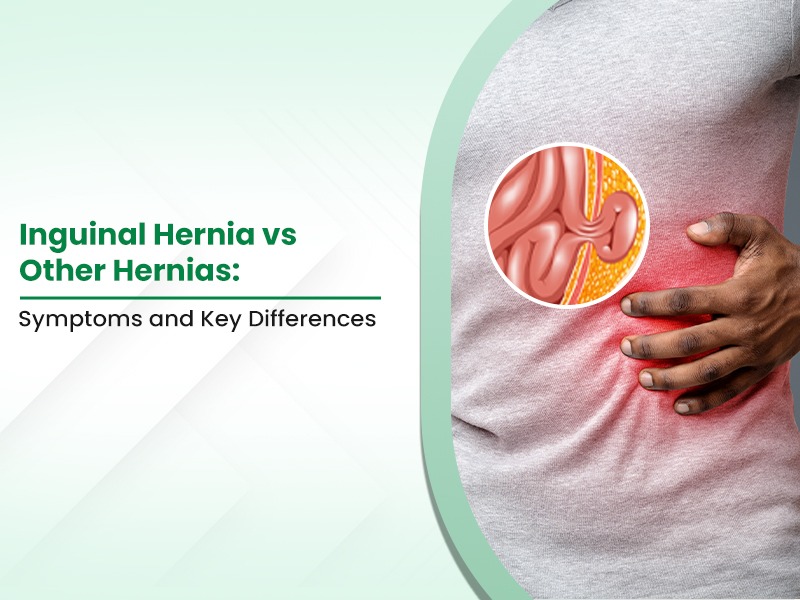
Inguinal Hernia vs Other Hernias: Symptoms and Key Differences
A lump that appears when you cough or strain and disappears when you get to normal posture or lie down. Most people notice it, make a mental note, and carry on. Weeks pass, sometimes months, with the assumption that it will resolve on its own. However, this could be a hernia. It does not heal without treatment and tends to grow slowly, and cause more discomfort over time. In some cases, a hernia can also become life-threatening. Therefore, understanding the type of hernia, its location, and how it feels is essential for seeking timely and appropriate care.
What Is a Hernia?
A hernia occurs when an internal organ or tissue pushes through a weak spot in the surrounding muscle wall, similar to how a weak patch in a tyre allows the inner tube to bulge outward.
The most commonly involved structures are parts of the intestine or fatty abdominal tissue. Some hernias are present from birth, while others develop gradually due to years of physical strain, chronic coughing, obesity, or weakness left after previous surgery. Therefore, whenever you observe any related signs, visit a hospital in Delhi NCR to get the right advice.
What Makes an Inguinal Hernia Different From the Rest?
Inguinal Hernia is the most common type by a wide margin account for around 75% of all abdominal wall hernias. It is also far more common in men, with about 1 in 4 men developing one at some point in their lives.
An inguinal hernia occurs when abdominal tissue pushes through a weak point in the lower abdominal wall into the inguinal canal, a natural passage in the groin that contains the spermatic cord in men and the round ligament in women.
- Indirect inguinal hernia (80% of cases): Most often congenital (present from birth). The inguinal canal does not close properly, leaving a gap through which tissue can slip and can appear at any age.
- Direct inguinal hernia (20% of cases): Develops in adult men due to gradual muscle weakening over time. Rarely seen in children or women.
Symptoms to Watch For
- A visible bulge on one or both sides of the groin, more noticeable when standing, coughing, or straining.
- Aching or burning sensation in the groin area.
- A heavy, dragging feeling that worsens as the day goes on.
- In men, swelling or discomfort may extend into the scrotum.
Symptoms often ease when lying down, which is a common pattern with this type of hernia.
How Do Other Hernia Types Compare with Inguinal Hernia?
Each hernia has its own location, set of symptoms, and level of risk. Here is how they are different from an inguinal hernia:
Femoral Hernia
This occurs just below the inguinal canal, through a narrower passage called the femoral canal. A femoral hernia is more common in women than men, which is one of the clearest differences from an inguinal hernia.
- The bulge appears lower in the groin, closer to the upper inner thigh.
- Often smaller and harder to detect.
- Carries a higher risk of strangulation (blood supply to trapped tissue being cut off) because of how narrow the femoral canal is.
Umbilical Hernia
This develops near the navel, where a natural gap in the abdominal wall exists from birth.
- Affects 10 to 15% of normal newborns and up to 10% of premature babies.
- In adults, repeated pregnancies, obesity, or chronic straining are common triggers.
- Presents as a soft, round bulge at or around the belly button, usually painless in early stages.
Hiatal Hernia
This type behaves differently from the others because there is no external bulge at all.
- The stomach pushes upward through the diaphragm (the muscle separating the chest and abdomen) into the chest cavity.
- Symptoms include heartburn, acid reflux, chest discomfort, and difficulty swallowing.
- Often discovered incidentally during an endoscopy.
Incisional Hernia
This develops at the site of a previous abdominal surgery, where scar tissue weakens over time.
- The bulge appears along or near the old surgical scar.
- Risk is higher with obesity, post-surgical wound infection, or returning to strenuous activity too soon after an operation.
- Accounts for approximately 10% of all hernia cases.
When Does a Hernia Become an Emergency?
Any hernia can turn dangerous if it becomes incarcerated (stuck and unable to return to the abdomen) or strangulated (blood supply to the trapped tissue is cut off, causing tissue death). In such cases, immediate medical attention is required you should visit the top hospital in Delhi NCR right away:
- Sudden and severe pain that worsens quickly
- A bulge that becomes red, dark, or extremely tender
- Nausea, vomiting, or inability to pass gas or stool
Get the Most Effective Hernia Care at Yashoda Medicity!
Hernias do not resolve on their own. Surgery remains the only definitive treatment, and at Yashoda Medicity, our surgical team has extensive experience in performing minimally invasive procedures across all hernia types, from routine inguinal repairs to complex recurrent and incisional cases.
If you notice an unexplained lump or persistent discomfort in your groin or abdomen, it is important to seek timely medical evaluation from the best surgeon in Ghaziabad at Yashoda Medicity today!
FAQs
- What is an inguinal hernia?
An inguinal hernia occurs when a part of the intestine pushes through a weak spot in the groin area. It shows up as a soft bulge that comes and goes.
- How is an inguinal hernia different from other types of hernias?
The difference lies in location. Inguinal hernias appear in the groin, whereas others form near the navel, stomach, or at old surgical scars.
- What are the common symptoms of an inguinal hernia?
A bulge in the groin, dull aching or burning sensation, and a heavy feeling that worsens through the day and eases when lying down.
- Are hernias more common in men than women?
Yes, significantly. Inguinal hernias are up to 10 times more common in men. About 1 in 4 men develops one at some point in life.
- Can a hernia heal without surgery?
No, unfortunately not. Hernias do not go away on their own. Surgery is the only reliable fix, and earlier is always better than later.