


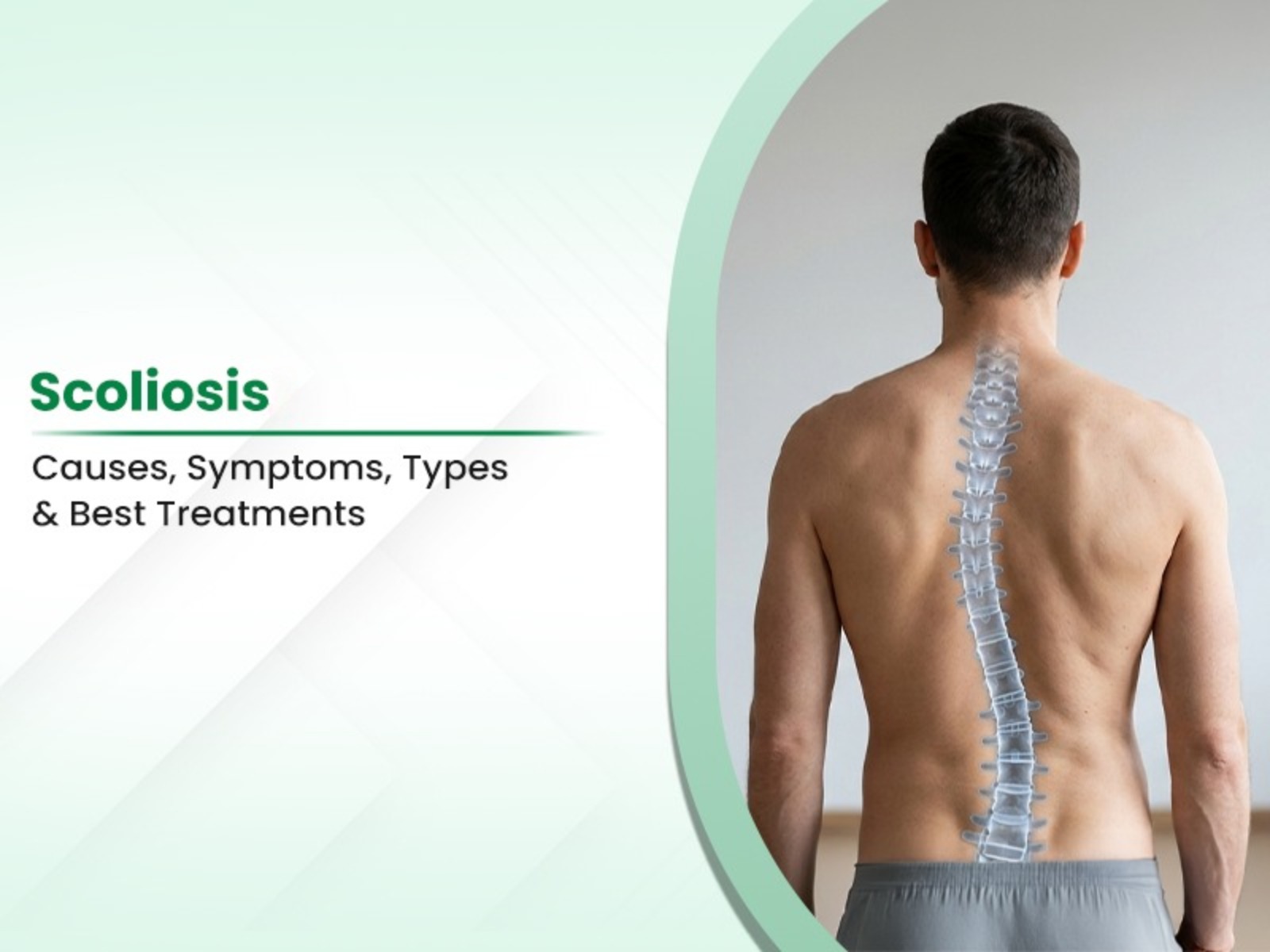
Scoliosis: Causes, Symptoms, Types & Best Treatments
Most people picture the spine as a straight column, but in reality, it has three natural front-to-back curves that help absorb shock and maintain balance. Scoliosis occurs when an additional sideways curvature of more than 10 degrees develops in the spine.
Scoliosis affects nearly 2 to 3% of people worldwide, which is about 1 in every 40 children. It most commonly appears during the rapid growth phase between ages 10 and 15, and girls are nearly 8 times more likely than boys to require active treatment. In general, the earlier it is detected, the simpler the management.
What Is Scoliosis?
Scoliosis is a sideways curvature of the spine, often forming an “S” or “C” shape, and it may also involve slight spinal rotation along its axis. The severity of the curve is measured using the Cobb angle on an X-ray:
- 10 to 24 degrees: Mild
- 25 to 39 degrees: Moderate
- 40 degrees and above: Severe
Curves below 10 degrees are not classified as scoliosis but are considered spinal asymmetry.
What Are The Causes and types of scoliosis in Children and Adults?
In nearly 80% of cases, the cause is unknown and is classified as idiopathic. The remaining cases are associated with identifiable conditions. The major types include:
- Juvenile Idiopathic (4 to 9 years): Less common, but important to monitor closely as progression may occur during growth spurts.
- Adolescent Idiopathic (10 to 18 years): The most common form, typically seen during puberty growth phases.
- Congenital (present at birth): Occurs when spinal bones do not form properly in the womb and is often detected early in childhood.
- Neuromuscular (any age): Seen in conditions such as cerebral palsy, muscular dystrophy, or spina bifida, where muscle control is affected.
- Degenerative (after 50 years): Occurs due to age-related wear and tear of spinal discs and joints, often associated with osteoporosis.
- Syndromic: Linked to conditions such as Marfan syndrome or Ehlers-Danlos syndrome, where scoliosis is one of multiple features.
What Are the Early Signs of Scoliosis to Watch For?
Early signs are usually visible before pain develops. Common indicators include:
- Uneven shoulders, with one shoulder blade appearing more prominent
- A tilted waistline or one hip appearing higher than the other
- A visible rib hump when bending forward (as seen in the Adam’s Forward Bend Test used in screening programmes)
- Clothes hanging unevenly or recurring issues with strap alignment
- Mild back fatigue or discomfort after prolonged sitting, especially in adults
- In severe cases (above 70 degrees), reduced lung capacity or breathlessness
If any of these signs are noticed, especially in children, early evaluation by an orthopaedic doctor in Indirapuram can confirm the diagnosis through examination and a standing full-spine X-ray.
How Is Scoliosis Diagnosed?
Diagnosis is straightforward and non-invasive. An orthopaedic specialist may recommend the following:
- Physical examination: Including the Adam’s Forward Bend Test to assess rib prominence
- Scoliometer measurement: A device used to measure trunk rotation; values above 7 degrees may require further evaluation
- Standing spine X-ray: Used to measure the Cobb angle and confirm diagnosis
- MRI scan: Recommended in cases with neurological symptoms, pain, or early-onset scoliosis (under 10 years of age)
A well-equipped bone and joint hospital in Delhi can complete these evaluations in a single visit and provide a clear treatment plan the same day.
How Is Scoliosis Treated?
Treatment of scoliosis depends mainly on the Cobb angle, the age of the patient, and how much growth is left.
Mild Curves (10 to 24°)
- Observation every 4 to 6 months with follow-up X-rays
- Physiotherapy, including Schroth method exercises to improve posture and muscle balance
- No bracing or surgery required in most cases
Moderate Curves (25 to 39°)
- Use of a spinal brace for 16 to 23 hours daily until skeletal maturity
- Bracing helps prevent progression in approximately 70% of cases
- Physiotherapy is continued alongside bracing
Severe Curves (40° and above)
- Spinal fusion surgery using rods and screws to correct and stabilise the spine
- Vertebral body tethering may be considered in selected growing children as a motion-preserving option
- Most patients return to school or work within 4 to 6 weeks and resume sports in about 6 months
A well-equipped hospital in Noida can provide complete care including screening, bracing, physiotherapy, and surgical management under one roof.
Get the Right Care for Scoliosis at Yashoda Medicity Today!
Scoliosis is significantly easier to manage when detected early. A simple screening today can prevent progression that may later require intensive treatment.
At Yashoda Medicity, our orthopaedic and spine specialists provide comprehensive care ranging from early diagnosis and conservative management to advanced surgical correction, all within a coordinated care system.
If any postural changes are noticed in a child or adult, early evaluation by the best orthopaedic doctor in Indirapuram is recommended.
FAQs
- What is scoliosis?
Scoliosis is a sideways curvature of the spine greater than 10 degrees, often appearing as an “S” or “C” shape. It commonly develops during childhood or adolescence. - What causes scoliosis in children and adults?
Most cases have no known cause. Other causes include genetic factors, neuromuscular conditions, birth defects, and age-related degeneration in adults. - What are the early signs of scoliosis?
Uneven shoulders, tilted waist, one hip higher than the other, rib prominence on bending forward, and uneven clothing alignment are common early signs. - What are the main types of scoliosis?
The main types include idiopathic, congenital, neuromuscular, degenerative, and syndromic scoliosis.
5. When is scoliosis surgery necessary?
Surgery is usually considered when the curve exceeds 45–50 degrees, progresses despite bracing, or begins affecting posture, breathing, or daily function.