


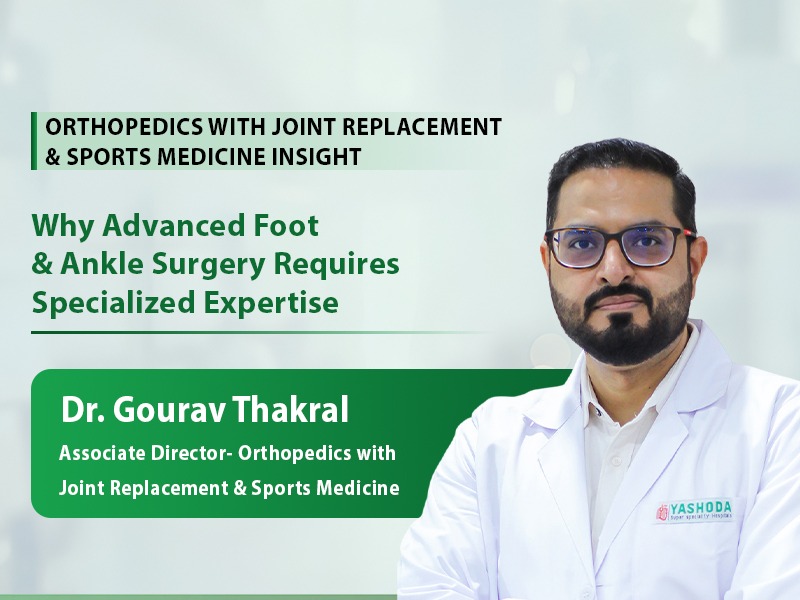
Why Advanced Foot & Ankle Surgery Requires Specialised Expertise
The human foot is a mechanical marvel made up of 26 bones, 33 joints, and more than a hundred muscles, tendons, and ligaments, all needing to work in perfect harmony to carry out the function of supporting our every step.
At Yashoda Medicity, we know that foot and ankle surgery isn’t only about fixing bones. It’s about giving people back their lives and enabling them to live a future without pain and full of activities. Through the combination of advanced Orthopaedics with Joint Replacement & Sports Medicine, we provide specialist care that ensures the treatment plan is tailored to the physiological uniqueness of every patient, from a professional athlete to an elderly person.
Why General Orthopedic Training Often Falls Short for Foot Disorders?
Indian healthcare is a long way from providing uniform foot and ankle care. Orthopedic, Joint Replacement & Sports Medicine Doctor in Delhi NCR undergoes courses that are dominated by studies of joint and spinal surgeries, and the foot’s anatomical complexities and treatment methods have not received enough space in the teaching syllabi.
The difference in treatment can be explained by the saying that “The eyes cannot see what the mind does not know.” In the absence of special knowledge, to a large extent, complex foot-related pain patients are incorrectly diagnosed as having merely “plantar fasciitis, ” treatment is limited to simple painkillers, and the root biomechanical problems, such as plano-valgus deformities or altered kinematics, are completely overlooked.
The Complexity of Foot Anatomy and Biomechanical Alignment
Advanced foot and ankle surgery demands a thorough grasp of body weight alignment in the legs and joint function. A hip or a knee mainly involves large-scale movements. However, the foot consists of small gliding motions through numerous tiny joints.
Complex Load Distribution: The foot must transition from a soft, flexible structure that can absorb shock to a stiff lever used to push off the ground.
- Intricate Neural Networks: Surgeons must work in a highly dense, nerve-racking area. Here, even a small deviation of a millimetre can affect sensory perception.
- Deformity Correction: Clubfoot, bunions, or post-traumatic malunions are some of the conditions that may require three-dimensional realignment, which is beyond the scope of regular orthopaedic procedures.
Managing the “Diabetic Capital” Challenges: A Specialized Approach
As India is the diabetic capital of the world, it poses distinctive problems in orthopaedic surgery. For diabetic foot complications such as neuropathy and Charcot arthropathy, the treatment requires a combination of vascular health and skeletal stability, which is best dealt with an interdisciplinary approach.
Heel Pain
- General Approach: Treatment usually includes analgesic medications and heel pads to reduce pain and pressure.
- Specialised Advanced Approach: Advanced evaluation with gait analysis and kinematic assessment to identify biomechanical issues and provide targeted treatment.
Ankle Injury
- General Approach: Initial management often involves standard X-ray imaging and rest to allow healing.
- Specialised Advanced Approach: MRI scans may be used to detect osteochondral lesions, followed by procedures such as Autologous Chondrocyte Implantation (ACI) if required.
Diabetic Ulcer
- General Approach: Managed with basic wound dressing and infection control.
- Specialised Advanced Approach: Advanced treatments such as revascularisation and limb salvage surgery to improve blood flow and prevent amputation.
Sports Injury
- General Approach: Treated with general physical therapy and rehabilitation exercises.
- Specialised Advanced Approach: Arthroscopic ligament repair and OATS (Osteochondral Autograft Transfer System) procedures for restoring joint stability and cartilage health.
The Role of Orthopedics with Joint Replacement & Sports Medicine
When this kind of surgery concerns Orthopaedics with Joint Replacement & Sports Medicine, the emphasis shifts from mere “repair” to “restoration of performance.” Highly sophisticated methods like Single-stage Osteochondral Autograft Transplant (OATS) or Autologous Chondrocyte Implantation (ACI) enable athletes to return to professional sports after the damaged cartilage has been regenerated, rather than merely having pain masked. Delivering this standard of care
Demands high-tech infrastructure, 3D printing for custom implants, and robotic-assisted precision, which, in fact, constitute the main features of such specialised centres.
Conclusion: Step into Excellence with Yashoda Medicity
The development of foot and ankle care in India is somewhat challenged. Inequalities in healthcare and issues with informal training still plague the sector. However, through specialisation, the path to a mobile, pain-free life is more transparent than ever.
At Yashoda Medicity, we find a way to link old-fashioned orthopedics and innovative surgical interventions. Our Department of Orthopaedics with Joint Replacement & Sports Medicine is focused on delivering accuracy, technology, and the integration of different disciplines that are indispensable for the treatment of severely complex lower-limb conditions.