


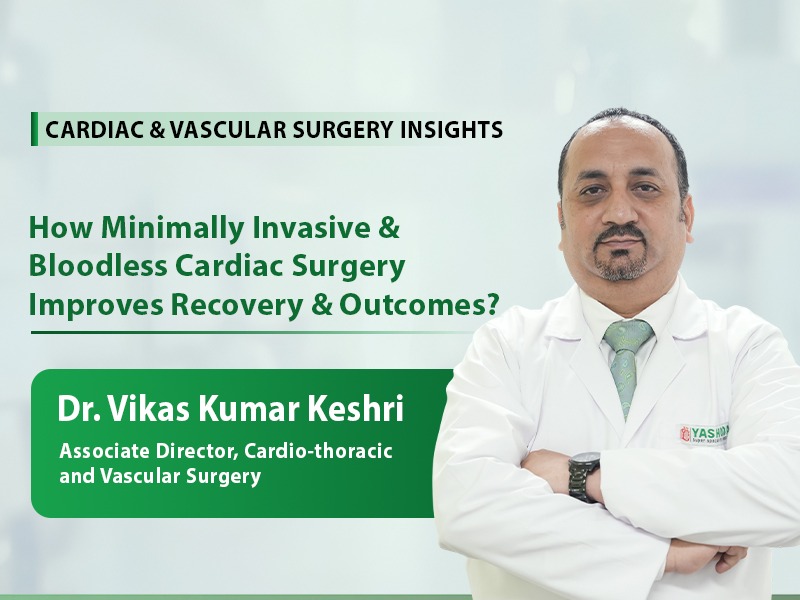
How Minimally Invasive and Bloodless Cardiac Surgery Improves Recovery and Outcomes?
Imagine a scenario where heart surgery does not entail a large chest incision or a very long recovery period. Thus, within a few days, you can come back to your life full of energy and enthusiasm. This is not a far, off future but a present reality of modern medicine. If you need the highest-quality heart care, the first step to accessing these revolutionary methods is to see a Cardiothoracic & Vascular Surgeon in Delhi NCR. Going through the baton of Dr. Vikas Kumar Keshari, Cardiothoracic & Vascular Surgeon, patients have been able to enjoy bloodless and minimally invasive procedures which emphasise safety, accuracy, and quick recovery of the body, thus bringing the healing process in the shortest time possible.
How Does Minimally Invasive Cardiac Surgery (MICS) Differ from Traditional Surgery?
In most cases, a traditional open-heart operation requires a sternotomy where the breastbone is cut to give direct access to the heart. On the other hand, Minimally Invasive Cardiac Surgery (MICS) only needs small incisions, usually around 2 to 3 inches, which are placed carefully between the ribs.
When the sternum is not broken, the chest is structurally left unchanged. Surgeons rely on specialised long-handled tools and high-definition thoracoscopes for intricate work. Such a procedure drastically reduces bodily trauma, decreases the risk of infection, and leaves a minimal surgical footprint on the patient’s body.
Why is Bloodless Surgery a Game-Changer for Patient Outcomes?
Bloodless surgery stands for a mix of medical and surgical methods aimed at significantly reducing blood loss and doing away with the necessity of allogeneic blood transfusions. For a Cardiothoracic & Vascular Surgeon in Delhi NCR, this translates into:
- Meticulous Dissection: Employing high-tech electrocautery and ultrasonic instruments to close vessels immediately.
- Cell Salvage: During surgery, the patient’s own blood is re-captured, cleaned, and re-injected in real time.
- Pre, operative Optimization: Elevating a patient’s natural haemoglobin levels by several weeks before the surgery.
By avoiding transfusions, the risk of patients developing immune complications and inflammatory responses is reduced, making the postoperative period much easier.
MICS CABG: Can Multi-Vessel Bypass Truly Be Simplified?
Minimally Invasive Coronary Artery Bypass Grafting (MICS CABG) has completely changed the game for patients with blocked arteries. One of the main differences from traditional bypass surgery is that with MICS CABG, the need for a heart-lung machine may be eliminated since it is usually done on a “beating heart, ” thus maintaining the natural function of the organs.
- Incision Size: Traditional CABG requires a larger 8–10 inch sternotomy incision, while MICS CABG uses a much smaller 2–3 inch thoracotomy incision.
- Hospital Stay: Patients undergoing Traditional CABG usually stay 7–10 days, whereas MICS CABG patients often recover faster with a 3–5 day stay.
- Recovery Time: Traditional CABG may take 6–12 weeks for full recovery, while MICS CABG recovery is quicker at 2–4 weeks.
- Blood Loss: Traditional CABG generally involves moderate to high blood loss, while MICS CABG is associated with minimal blood loss.
This method makes it easier for patients with multi-vessel disease to get back to physical activity more quickly without the surgical limitation of a broken breastbone.
Expert Consultation with Dr. Vikas Kumar Keshari
Patients diagnosed with heart disease will find a well-qualified professional to lead them through such advanced treatment options in Dr. Vikas Kumar Keshari, Cardiothoracic & Vascular Surgeon. Dr. Vikas Kumar Keshari, a renowned patient-centred surgeon with remarkable skills, specialises in combining minimally invasive and bloodless cardiac surgery methods. He is particularly passionate about personalised assessments and, hence, ensuring that each patient receives an optimal treatment plan not only for their anatomy but also for their overall lifespan.
Conclusion: A New Standard of Care at Yashoda Medicity
The emergence of minimally invasive procedures and robotic heart surgeries represents a radical shift, with the primary criterion for success being the patient’s quality of life. Yashoda Medicity is a part of the ClearMedi Healthcare network, and we are devoted to spreading access to quality healthcare throughout India.
We are an NABH-accredited hospital with an outstanding success rate of 99.5% in performing more than 3,200 minimally invasive surgeries. We offer world-class technology combined with a highly trained and compassionate team.