


How Da Vinci Xi Robotic Surgical System Works: Benefits, Procedure & Recovery Explained
For years, the words “robot” and “surgery” sounded like something from a sci-fi movie. Today, the Da Vinci Xi Robotic Surgical System is used in operating theatres across more than 70 countries, with over 14 million surgeries performed worldwide. While it is often assumed that the robot performs the surgery, the reality is quite different. The surgeon remains fully in control from a console, while the system translates their hand movements into far steadier and more precise motions than a human wrist can achieve.
As a result, robotic surgery allows smaller cuts, less bleeding, reduced pain, and a faster return to normal life. To understand this better, let’s look at how the system works, its benefits, and the recovery process.
What Is the Da Vinci Xi Robotic Surgical System?
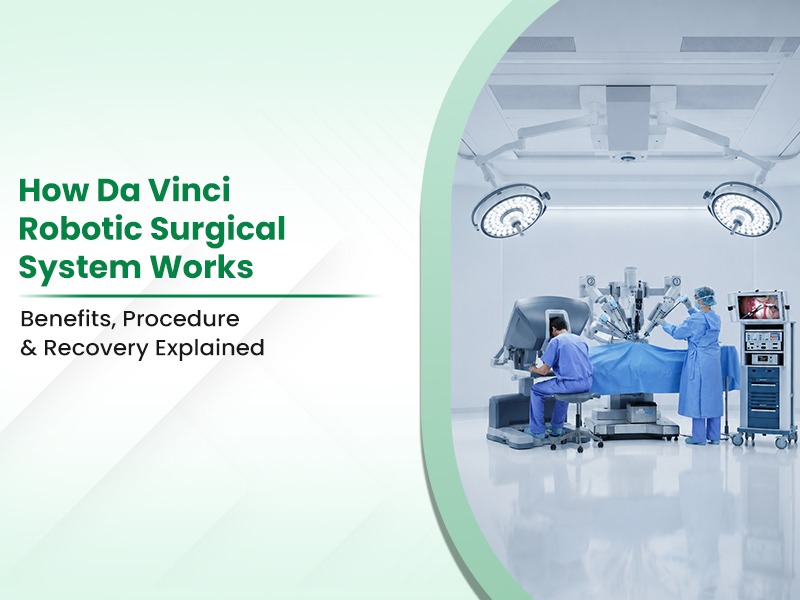
The Da Vinci system works through three integrated components that function together during surgery.
- First, the surgeon console allows the doctor to sit comfortably and view a magnified 3D image of the surgical area while controlling master instruments using hand and foot controls.
- Next, the patient cart carries four robotic arms equipped with miniature surgical tools and a high-definition camera, which are inserted through very small incisions, often as small as 8 mm (about the size of a pencil tip).
- Finally, the vision cart processes and delivers a live 3D image, magnified up to 10 times, to enhance precision.
Together, these components allow the robotic arms to rotate up to 540 degrees, enabling highly precise movements in extremely confined spaces.
How Is Robotic Surgery Different From Traditional Surgery?
To understand the advantage of robotic surgery, it helps to compare it with traditional approaches.
Open surgery typically requires one large incision of 15 to 25 cm, while laparoscopic surgery is less invasive but still limited by rigid instruments that do not bend easily. In contrast, robotic surgery combines the advantages of both while overcoming their limitations.
For example:
- Cuts: Instead of one large incision, robotic surgery uses 4 to 5 small ports of 8–12 mm
- Vision: It provides true 3D, 10x magnification instead of flat or direct 2D vision
- Tools: The instruments mimic human wrist movements without tremor
- Blood loss: Often under 100 ml compared to 300–500 ml in open surgery
- Hospital stay: Typically 1 to 3 days instead of 5 to 7 days
- Return to work: Usually 2 to 3 weeks instead of 6 to 8 weeks
Importantly, the surgeon remains in complete control at all times, and the robotic system only enhances precision and stability.
Which Surgeries Can the Da Vinci Xi Robotic Surgical System Perform?
Because of its precision, the Da Vinci Xi Robotic Surgical System is used across multiple specialties and complex procedures.
In urology, it is commonly used for prostate cancer surgery, kidney cancer, partial nephrectomy, and bladder reconstruction. In fact, a trained urologist in Ghaziabad can perform nerve-sparing procedures that help preserve urinary control and sexual function.
Similarly, in gynaecology, it is used for hysterectomy, fibroid removal, endometriosis treatment, and ovarian cyst removal. In cancer surgery, it supports colorectal, rectal, pancreatic (Whipple’s procedure), liver resections, and head and neck tumour surgeries.
Beyond this, in general surgery, it is used for hernia repair, gallbladder removal, and anti-reflux procedures. In cardiac and chest surgery, it assists in mitral valve repair, lung lobectomy, and thymus surgery. It is also increasingly used in weight loss surgery, including robotic gastric bypass and sleeve gastrectomy.
What Are the Benefits of the Da Vinci Xi Robotic Surgical System?
The advantages of robotic surgery become clearer when looking at recovery and outcomes together.
Because the incisions are smaller, patients experience less pain and require lower doses of pain medication. At the same time, there is 70–80% less blood loss compared to open surgery, which also reduces the risk of complications.
In addition, the smaller wounds lead to a lower risk of infection and faster healing. Since the surgical precision is higher, there is also better preservation of nerves and healthy tissue, which is especially important in cancer and reproductive surgeries.
All of this contributes to faster recovery, with most patients walking within 24 hours and resuming oral intake by day 2. Hospital stays are also shorter by 2 to 4 days, and cosmetic outcomes are significantly better due to minimal scarring.
To ensure suitability for surgery, a pre-operative evaluation with the best physician in Ghaziabad can help complete all fitness assessments, anaesthesia clearance, and preparation in just one or two visits.
What Does the Day of Surgery and Recovery Look Like?
On the day of surgery, the patient is placed under general anaesthesia. The surgical team then creates 4 to 5 small incisions through which the camera and instruments are inserted. While this happens, the surgeon operates from the nearby console with full control over every movement. Most procedures take around 2 to 4 hours.
Recovery typically follows a predictable pattern:
- Day 0: The patient wakes up in recovery within 1 to 2 hours, with mild pain managed using oral medication
- Day 1: Sitting up, sipping fluids, and walking short distances with assistance begins
- Day 2–3: Transition to soft food, increased mobility, and discharge in most cases
- Week 1–2: Gradual return to desk work or short drives
- Week 3–4: Resumption of most daily activities and light exercise
- Week 6: Full recovery in complex procedures
For best outcomes, patients are advised to choose a super speciality hospital near me with a dedicated robotic surgery team, as coordinated care significantly improves recovery efficiency.
Visit Yashoda Medicity Today For Robotic Surgery!
Robotic surgery is no longer a future concept; it is already transforming surgical care and recovery outcomes worldwide. At Yashoda Medicity, our trained robotic surgery team uses the Da Vinci Xi robotic surgical system across urology, oncology, gynaecology, and general surgery, supported by an in-house Robotic-Assisted Surgery Training Centre.
Therefore, if the best urologist in Ghaziabad recommends robotic surgery, it is worth visiting the hospital to evaluate whether a robotic approach is suitable for your condition and to understand the available advanced treatment options.
FAQs
- What is the Da Vinci Xi Robotic Surgical System?
It is a surgeon-controlled system with a 3D console, robotic arms, and a high-definition camera that enables precise, minimally invasive surgery through small incisions.
- How does robotic surgery differ from traditional surgery?
Unlike open surgery, it uses small incisions, provides 3D magnified vision, eliminates tremor, reduces blood loss, and shortens recovery time.
- What procedures can be done using Da Vinci Xi Robotic Surgical System technology?
It is used in urology, gynaecology, cancer surgery, general surgery, cardiac procedures, and weight-loss surgeries, including prostate, colorectal, pancreatic, and liver operations.
- What are the benefits of robotic-assisted surgery?
It offers less pain, significantly reduced bleeding, lower infection risk, faster recovery, shorter hospital stay, and better cosmetic outcomes compared to open surgery.
- Is robotic surgery less painful than open surgery?
Yes. Because of smaller incisions and minimal tissue handling, patients experience less postoperative pain, require fewer painkillers, and are able to walk within 24 hours in most cases.