


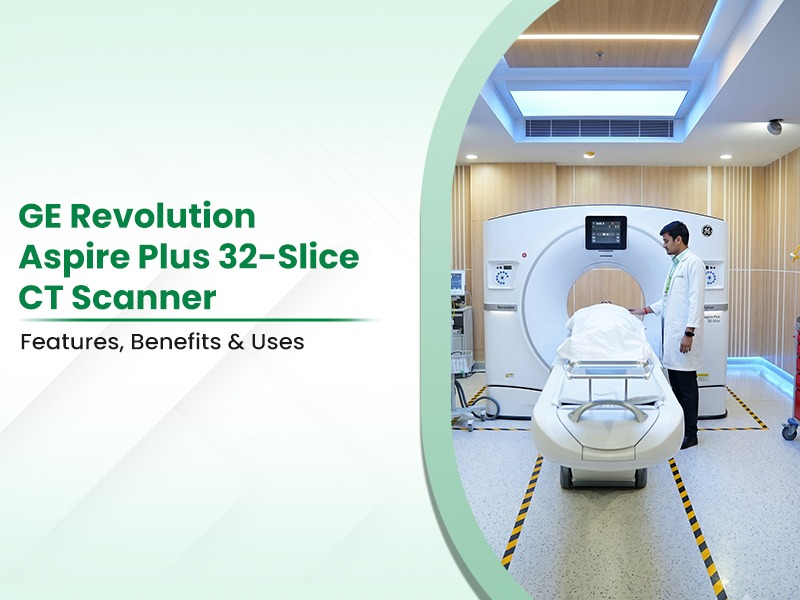
GE Revolution Aspire Plus 32-Slice CT Scanner: Features, Benefits & Uses
When a doctor recommends an imaging test, prescriptions often include terms such as CECT abdomen, HRCT chest, or CT angiography, along with numbers like 16, 32, 64, or 128 next to the machine type. These numbers refer to “slices,” which determine the level of detail the scan can capture.
Among these, the GE Revolution Aspire Plus 32-slice CT scanner is widely used as a reliable, fast, and high-quality imaging system for routine diagnostic needs. To understand its relevance, it is important to look at how it works, what makes it effective, and where it is commonly used.
What Does a 32-Slice CT Actually Do?
A computed tomography (CT) scanner uses X-rays that rotate around the body to create detailed cross-sectional images. These images allow doctors to see internal structures such as organs, bones, blood vessels, and tissues in high detail.
The term “32-slice” refers to the number of image slices captured in a single rotation. A 32-slice scanner captures 32 image layers per rotation, allowing it to build a detailed 3D representation of the body in just a few seconds.
As a result, it is commonly used for routine clinical conditions such as fractures, strokes, infections, abdominal pain, and evaluation of lung or kidney stones. In most day-to-day diagnostic decisions, a 32-slice CT remains a widely preferred option.
What Features Make the GE Aspire Plus CT Scanner Stand Out?
While many hospitals operate 32-slice CT scanners, performance can vary significantly. The GE Revolution Aspire Plus stands out due to a combination of speed, clarity, and patient comfort features:
- 0.8-second rotation time: Ensures the scan is completed before most patients complete a single breath-hold
- 50% higher patient throughput: Reduces waiting time in busy emergency settings
- 30% sharper image quality: Enabled by the GE Clarity Imaging Chain
- Up to 40% lower radiation dose: Using ASiR (Adaptive Statistical Iterative Reconstruction) and Organ Dose Modulation, which help protect sensitive organs such as the thyroid, eyes, and breasts
- 70 cm wide bore and 180 kg table capacity: Improves comfort for claustrophobic, elderly, or larger patients
- SmartPlan and SmartPrep (AI-assisted): Helps with precise positioning and automated contrast timing
- Smart MAR technology: Reduces image distortion caused by metal implants such as joint replacements, dental work, or surgical screws
Because of these features, most routine scans can be completed in 5 to 10 minutes, with same-day reporting in many cases at a well-equipped hospital in Ghaziabad.
When Will Your Doctor Actually Suggest a CT?
CT scans are typically recommended when an X-ray is not detailed enough and an MRI may not be immediately required or available. In such cases, a GE Revolution 32-slice CT scanner is commonly used across multiple specialties.
Cancer Care
CT scans help detect tumours as small as 5 mm in organs such as the lungs, liver, kidneys, pancreas, and abdomen. They are also essential for cancer staging and treatment planning. An experienced oncologist in Delhi NCR uses CT findings to decide whether surgery, chemotherapy, or radiation is most appropriate.
Bones and Joints
CT imaging is highly effective in identifying subtle fractures, complex spine injuries, and joint damage that may not appear on X-rays. An orthopaedic in Ghaziabad often relies on CT data for precise surgical planning, including joint replacement procedures.
Brain and Stroke
CT scans play a critical role in detecting brain bleeding, clots, and stroke within minutes. This is especially important because clot-dissolving treatment is most effective within 4.5 hours of symptom onset.
Heart and Lungs
CT scans are also used to detect coronary artery blockages, pulmonary embolism (lung clots), pneumonia, and tuberculosis-related changes with high accuracy.
Emergencies
In trauma cases, CT helps quickly identify internal bleeding, organ injury, or acute appendicitis, often within minutes, making it crucial in emergency care.
Choose Yashoda Medicity For Faster, Safer and Precise Diagnosis!
Diagnostic imaging should be seamless, accurate, and stress-free. At Yashoda Medicity, the GE Revolution Aspire Plus 32-slice CT scanner is part of a comprehensive imaging ecosystem that also includes 256-slice spectral CT, 3T MRI, and AI-supported reporting, all available under one roof.
If your doctor has advised a CT scan, you can walk in or book your appointment online. Our team ensures a fast, safe, and clearly explained diagnostic experience from scan to final report.
Also Read: Cancer Hospital in Delhi
FAQs
- What is a 32-slice CT scanner?
A 32-slice CT scanner captures 32 cross-sectional images per rotation, providing a detailed 3D view of internal organs, bones, and blood vessels in a quick scan, usually completed within 5 to 10 minutes. - What are the features of the GE Revolution Aspire Plus CT scanner?
It includes a 0.8-second rotation speed, 70 cm wide bore, 180 kg capacity, low-dose ASiR imaging, AI-based SmartPlan and SmartPrep, and Smart MAR technology for metal artifact reduction. - What conditions can a CT scan diagnose?
CT scans help diagnose cancer, fractures, stroke, internal bleeding, lung clots, infections, kidney stones, and trauma-related injuries with high accuracy and fast reporting. - Is a CT scan painless?
Yes. A CT scan is completely painless. The patient simply lies on a table that moves through the scanner. If contrast dye is used, a brief warm sensation may be felt.
5. How long does a CT scan take?
Most scans on the Revolution Aspire Plus are completed within 5 to 10 minutes, with reports often available within a few hours, depending on urgency.